
最新动态
DIW065SIC080 | Cooler by Design
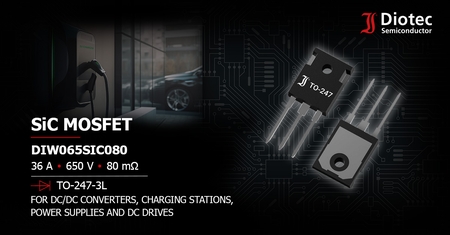
Thermal management can make or break the lifetime of a power electronic design. With Diotec’s DIW065SIC080, careful attention to the complete thermal path helps designers turn high-power performance into long-term reliability.
In power electronics, temperature is one of the most important - and often underestimated - factors affecting lifetime. A device may be electrically rated for demanding conditions, but excessive junction temperature can dramatically accelerate ageing.
The Arrhenius law illustrates just how significant the effect can be: as a rule of thumb, every 10 K increase in temperature can halve the lifetime of a physical device. A seemingly modest increase from 80°C to 110°C can therefore turn an intended 20-year lifetime into just a few years.
For power designs using the DIW065SIC080, thermal management is consequently an integral part of the design process.
Designed with the complete thermal path in mind
Real-world operating conditions can be far more demanding than the ideal 25°C ambient often associated with commercial applications. Industrial equipment may face 50°C ambient temperatures, while automotive applications can experience around 75°C.
The key is to keep the junction temperature as low as possible.
A thermal equivalent circuit makes this process straightforward. Temperature can be treated like voltage, power loss like current and thermal resistance like electrical resistance. This allows designers to calculate the temperature rise through the complete thermal path - from junction to case, heatsink and ambient - and even model thermal behavior in SPICE.
For short, high-power pulses, the DIW065SIC080's thermal performance should also be considered using transient thermal impedance (Zth) rather than relying solely on steady-state Rth. The copper baseplate of a power package provides significant thermal capacity, allowing short power pulses to be handled more effectively than a steady-state calculation might suggest.
Assembly matters
Even the best thermal design can be compromised by poor mechanical assembly.
The DIW065SIC080 can be mounted to a heatsink using an appropriate clamping or screw-mounted solution. Correct mounting pressure is essential for efficient heat transfer. For the device, the specified mounting torque is 1 ± 10% Nm - a value that should be carefully observed during assembly.
Excessive torque can damage the package, while insufficient torque can increase thermal resistance at the interface.
A thin layer of thermal grease can further improve heat transfer between the device's thermal surface and heatsink. Rather than applying excessive paste, the optimum thickness should be established practically: the final interface should be completely covered by a thin, uniform layer without excessive grease escaping around the edges.
Realistic specifications, realistic results
Thermal-resistance figures should always be considered in the context of the conditions under which they were measured.
Some semiconductor specifications may appear exceptionally attractive because they are based on very large solder pad areas that are difficult to reproduce in practical PCB designs. For this reason, thermal performance should always be compared using realistic pad sizes and application conditions.
This approach helps ensure that the DIW065SIC080 by Diotec delivers the expected thermal performance not only on paper, but in the finished application.
Verify the design in practice
Calculation is the starting point - measurement provides the confirmation.
Once the PCB layout, pad dimensions and heatsink have been defined, thermal-camera measurements can be used to verify the actual operating temperature. When measuring metallic semiconductor cases, the surface should first be blackened with a permanent marker to improve infrared emissivity and measurement accuracy.
For maximum lifetime and reliability, a junction temperature of around 80°C is a useful design target. Although some semiconductor devices can be rated for junction temperatures up to 175°C, maximum ratings represent limits rather than ideal continuous operating conditions. Keeping continuous temperatures below approximately 100°C provides significantly more thermal headroom.
Thermal performance is part of the design
The DIW065SIC080 demonstrates an important principle in power electronics: reliable semiconductor operation depends on more than electrical specifications alone.
By combining the device's electrical capabilities with appropriate heatsink selection, correct mounting torque, optimized thermal-paste application and practical temperature verification, designers can create power stages that are not only powerful, but built for the long term.
For the DIW065SIC080, effective thermal management is more than cooling the device - it is a key part of unlocking its reliability potential.
- Applications
- Mobility cn > application > mobility
- Product families
- SiC MOSFETs cn > productlist > SIC-FET