
最新动态
SIT30C065 | Efficient SiC Schottky Technology for Demanding Power Applications
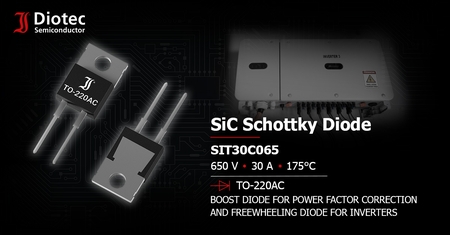
Thermal management plays a key role in unlocking the reliability and performance of modern SiC power semiconductors.
As power electronics become more compact and efficient, semiconductor devices need to operate under increasingly demanding electrical and thermal conditions. Diotec’s SIT30C065 SiC Schottky diode is designed for applications where high efficiency, fast switching and reliable operation are essential.
Silicon carbide (SiC) Schottky technology offers significant advantages for high-frequency power conversion. Unlike conventional silicon diodes, SiC Schottky diodes have no significant reverse-recovery charge, helping to reduce switching losses and improve overall system efficiency. This makes them particularly attractive for high-frequency applications where switching performance has a direct impact on power dissipation and thermal management.
Thermal design remains essential
Even with the efficiency advantages of SiC, thermal considerations remain critical because semiconductor lifetime is strongly influenced by temperature.
The SIT30C065 should therefore always be considered as part of the complete thermal system. Power losses, PCB copper area, mounting conditions and, where required, heatsink performance all contribute to the final junction temperature.
For Schottky diodes, reverse leakage current can form a more significant part of the total losses than in many conventional rectifiers. Designers should therefore consider both forward-conduction losses and leakage when calculating the device's total power dissipation, particularly at elevated temperatures.
Designed for high-frequency operation
The absence of significant reverse-recovery losses is one of the key benefits of SiC Schottky technology. This allows the SIT30C065 to support efficient operation at high switching frequencies, helping designers reduce the size of passive components and increase power density.
Nevertheless, switching behaviour is application-dependent. Measuring the actual current and voltage waveforms in the final circuit can provide valuable insight into the real losses and thermal performance of the diode.
Making the most of thermal capacity
For pulsed or intermittent operation, transient thermal impedance (Zth) can provide a more realistic picture of device behaviour than steady-state thermal resistance alone. The thermal capacity of the package and PCB can temporarily absorb heat, allowing short-duration high-power loads without immediately reaching the steady-state temperature.
This can be particularly relevant when designing compact, high-power systems around SiC devices.
Practical thermal verification
Once the SIT30C065 has been mounted on the intended PCB or heatsink, practical temperature measurements are recommended.
Thermal cameras can be a useful tool for identifying hot spots, although shiny metallic surfaces can give misleading readings because of their low emissivity. For reliable measurements, the relevant metal surface can be marked with a high-emissivity coating such as a permanent marker.
As a general guideline for high reliability and long service life, a junction temperature around 80°C is a useful target. The maximum junction temperature specified for a semiconductor represents an absolute operating limit, not necessarily a desirable continuous operating temperature.
Efficiency and reliability go hand in hand
The SIT30C065 by Diotec combines the inherent high-frequency switching advantages of SiC technology with the need for careful thermal design. By taking power losses, operating frequency, PCB layout and cooling conditions into account from the start, engineers can take full advantage of SiC technology while maintaining the thermal margin needed for reliable, long-term operation.
For today's increasingly compact and power-dense converters, thoughtful thermal design is not simply a precaution - it is an essential part of achieving the efficiency and reliability that modern power electronics demand.
- Products
- SIT30C065 cn > product > SIT30C065
- Applications
- Mobility cn > application > mobility
- Product families
- SiC Schottky Diodes cn > productlist > SIC-SBD